
Experiencing sudden hearing loss or a persistent ringing sound (tinnitus) after a diving trip or a traffic accident can be terrifying. It is often impossible to tell by feeling alone whether the blockage is caused by simple ear wax, an infection, or permanent nerve damage. At Hydro Medical, we use Audiometry—the gold standard in hearing diagnostics—as part of our comprehensive ENT medical protocols to provide you with an accurate assessment and a clear path to recovery.

What is an Audiometry Test?
Pure Tone Audiometry is a non-invasive diagnostic procedure that measures your hearing threshold across various frequencies (pitch) and intensities (loudness). During this painless test, you wear specialized headphones in a quiet environment and simply press a button whenever you detect a tone, ranging from deep bass to high-pitched beeps.
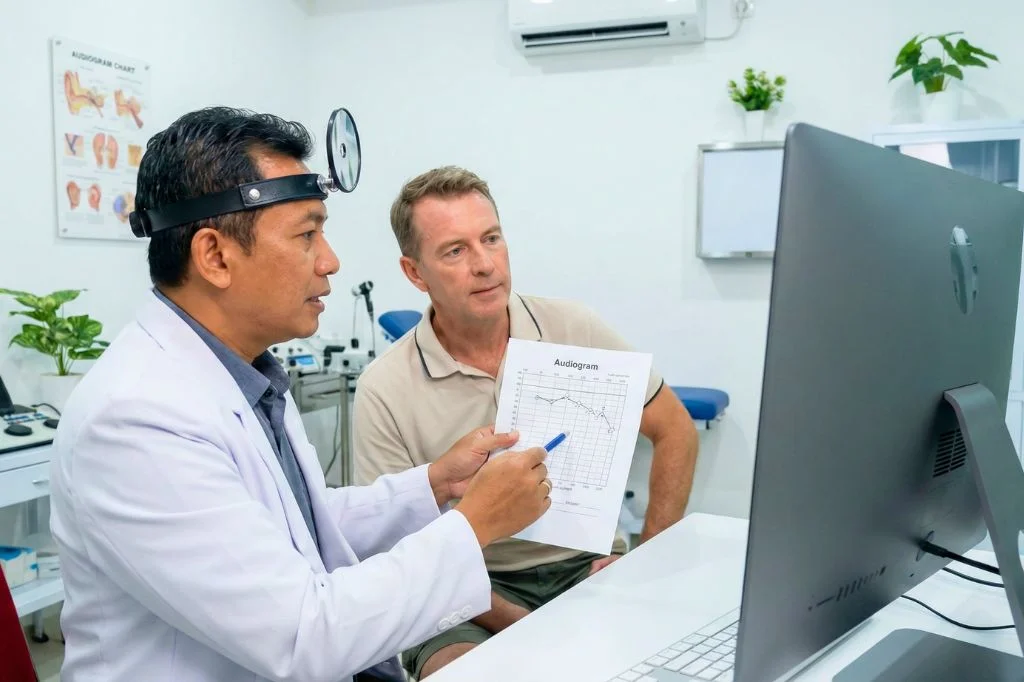
The results are instantly plotted on an Audiogram, a precise graph that allows our doctors to map your degree of hearing loss in Decibels (dB).
When Do You Need This Test? (Common Causes in Bali)
While routine checks are good, certain activities and incidents in Bali make this test urgent. You should schedule an assessment if you experience hearing changes following:
- Barotrauma (Diving & Flying): Rapid pressure changes can stretch or rupture the eardrum. If your ears feel “full” or muffled for days after airplane ear barotrauma treatment, audiometry is required to rule out inner ear damage.
- Head Trauma: Motorbike accidents are common in Bali. A blow to the head can fracture the temporal bone or bruise the auditory nerve, leading to instant hearing loss.
- Acoustic Trauma: Exposure to extremely loud noise (like club speakers or explosions) can damage the hair cells in the cochlea.
- Persistent Tinnitus: If you hear a constant ringing, buzzing, or hissing sound that does not go away, especially after a persistent ear infection.
Types of Hearing Loss We Can Detect
The primary goal of the audiogram is to categorize the type of hearing loss, which determines the treatment:
- Conductive Hearing Loss: The problem lies in the outer or middle ear (e.g., a ruptured eardrum or fluid blockage). This is often temporary and treatable with medication or minor procedures.
- Sensorineural Hearing Loss: The damage is in the inner ear (cochlea) or the auditory nerve. This is often permanent, but immediate treatment with steroids within the “Golden Period” (under 72 hours) can sometimes restore hearing.
- Mixed Hearing Loss: A combination of both conductive and sensorineural issues.
The Procedure at Hydro Medical
We ensure every hearing assessment is thorough and accurate by following a three-step process:
- Otoscopy (Physical Check): Before testing, our doctor examines your ear canal using a light. We must ensure the path is clear; if there is a blockage, we perform ear wax removal first, as impacted wax can skew the test results.
- Pure Tone Audiometry: You undergo the hearing test in a controlled environment to map out your hearing thresholds for both air conduction (headphone) and bone conduction (vibration).
- Specialist Consultation: Our ENT Specialist analyzes the audiogram. We explain whether your hearing loss is mild, moderate, or severe, and recommend the appropriate medical therapy or referral.
Conclusion
When it comes to your senses, never rely on guesswork. A precise diagnosis is the first step toward recovery. If your hearing feels muffled or damaged, schedule a professional audiometry test today at Hydro Medical to understand exactly what is happening inside your ears.
CHECK YOUR HEARING TODAY.
Don’t let hearing loss go undiagnosed. Schedule a professional Audiometry test with our ENT team for peace of mind.
Frequently Asked Questions
Is the audiometry test painful?
No, absolutely not. It is a non-invasive test where you simply wear headphones and listen to sounds. There is no physical discomfort.
How long does the test take?
The test itself usually takes about 15–20 minutes. However, combined with the doctor’s consultation and initial examination, the whole session takes about 30–45 minutes.
Do I need an audiometry test if I have ear wax?
No. We must clear the ear wax first. If the ear canal is blocked, the test results will be inaccurate. Our doctor will clean your ears before performing the test.
Can this test detect a ruptured eardrum?
The test detects the hearing loss caused by a rupture (Conductive Loss). To see the physical rupture itself, the doctor uses an Otoscope or Endoscope alongside the audiometry test.
How soon after diving should I get tested?
If you experience sudden hearing loss or severe ringing immediately after surfacing, you should get tested ASAP. Quick diagnosis helps in treating Decompression Sickness or Barotrauma effectively.
Can I get the results immediately?
Yes. The audiogram (chart) is generated instantly, and our ENT specialist will explain the results to you right away during the consultation.
Is this test suitable for children?
Yes, for older children who can follow instructions (raise a hand when they hear a beep). For toddlers/babies, different specialized tests (OAE/BERA) are needed.
What is the difference between air and bone conduction?
Air conduction tests the whole ear (outer, middle, inner) using headphones. Bone conduction tests only the inner ear using a vibrator behind the ear. Comparing them helps us pinpoint where the damage is.
Can you treat hearing loss at Hydro Medical?
We treat medically treatable hearing loss (infections, inflammation, sudden deafness with steroids). If the loss is permanent/structural, we can refer you for hearing aids or surgery.
Do I need a referral for this test?
No, you can book an appointment directly with our ENT clinic for a hearing assessment.