
After learning the ABCDE framework, the natural next question is what a dermatologist actually uses to check more precisely than the eye alone. Our dermatologist in Bali uses a specific tool for this, one that looks intimidating at first glance but is actually a fairly simple concept once it’s explained, and understanding what it does makes the whole process feel a lot less like a mystery, and a lot more like something worth being curious about rather than nervous about.
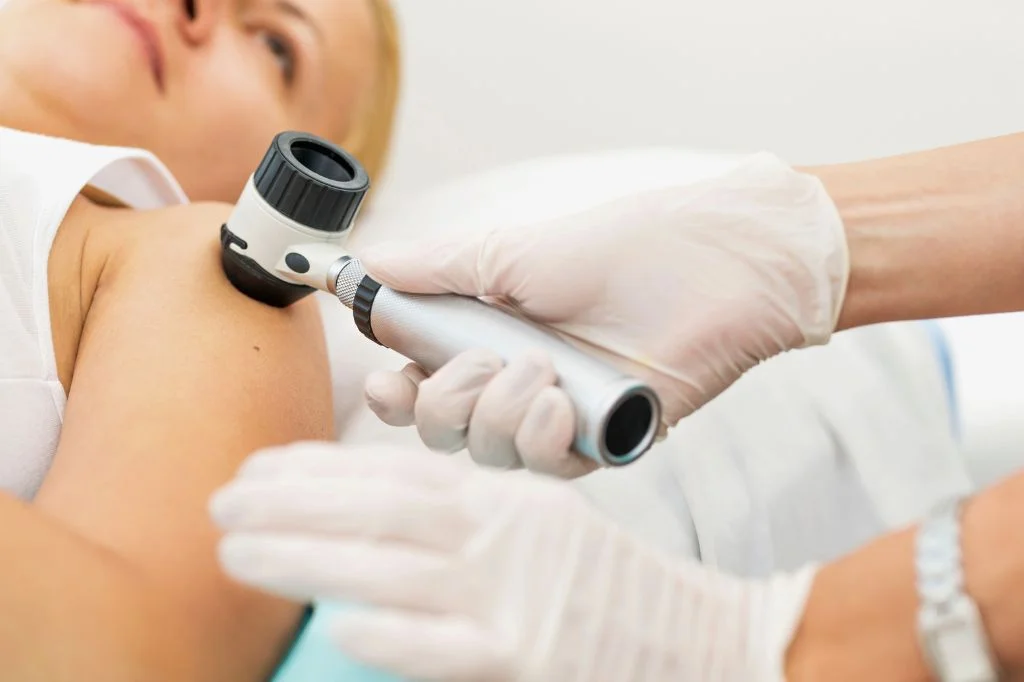
A Magnifier With a Purpose
The tool is called a dermatoscope, a specialized handheld magnifier used during a skin exam. It’s non-invasive and painless, your dermatologist either holds it just above the skin or rests it gently on the surface, magnifying what’s underneath about 10 times larger than the naked eye can see, roughly the difference between glancing at something and examining it closely.
It’s typically used after an initial visual inspection, on spots that look worth a closer look rather than on every inch of skin as a matter of course, so the exam itself still starts the same way any skin check would, with a straightforward look at your skin overall, and the scope comes in only when something warrants extra attention.
How It Sees What the Eye Can’t
The device works through polarization, which reduces scattered and reflected light on the skin’s surface. That filtering effect lets a dermatologist see past the surface and into the two layers beneath it, the epidermis and dermis, where structural changes aren’t visible to the naked eye at all, the same way a fogged window can be cleared to reveal what’s actually on the other side.
It’s this deeper view that makes the difference, a visual exam alone can only judge shape and color from the outside, dermoscopy shows what’s actually happening underneath, which is exactly the kind of detail the ABCDE checklist can’t capture on its own, no matter how carefully you look.
Why It Changes the Odds
According to The Skin Cancer Foundation, a 2024 study led by a UCSF dermatology researcher measured just how much of a difference this makes:
- Experienced dermatologists were nearly 6 times better at identifying melanoma using dermoscopy compared with visual examination alone
- When using dermoscopic imaging, dermatologists were more than 13 times more likely to accurately diagnose melanoma than primary care physicians
- Dermatologists were 2.5 times better at diagnosing nonmelanoma skin cancers, like basal cell and squamous cell carcinoma, versus standard inspection
None of this replaces clinical judgment, dermoscopy informs it, giving a dermatologist far more to work with than sight alone, which is really the whole point of the technology, precision that supports a trained eye rather than replacing it.
What the Scope Doesn’t Mean
Seeing the scope come out during your visit isn’t itself a signal of concern, it’s simply part of a thorough check:
- Most lesions examined this way turn out to be benign, which is genuinely reassuring news each time it happens
- Its precision helps avoid unnecessary biopsies, and the scarring, discomfort, and waiting that come with them
- It’s often used on completely ordinary moles simply to document a clear baseline for future visits
Between visits, the ABCDE rule is still the useful thing to keep in mind, it’s what tells you when a professional look is worth booking in the first place, dermoscopy and self-awareness are complementary, not competing, tools.

How Hydro Medical Helps
At Hydro Medical, dermoscopy is standard for every mole check, not an upgrade or an extra step, performed by a dermatologist trained to interpret exactly what it shows. Our English-fluent team offers this across our clinics in Canggu, Seminyak, and Kuta, so nothing about the process feels unfamiliar or hard to follow, whether it’s your first mole check or your fifth.
For anyone with a lot of moles or a higher-risk profile, a more thorough mole mapping appointment builds on this same technology to track your skin over time, comparing new images against a documented baseline rather than relying on memory alone.
Frequently Asked Questions (FAQ)
Does dermoscopy hurt?
No, the device is simply placed on or held just above the skin, there’s no pain or preparation involved.
Why would my dermatologist use the scope if nothing looks wrong?
It’s standard practice for a thorough check, not a sign of concern, and it’s often used on ordinary moles simply to document a clear baseline.
Is dermoscopy the same as a biopsy?
No, it’s a non-invasive visual examination. If something does need further investigation, a biopsy is a separate, deliberate next step, not an automatic one, and it’s explained clearly before it happens.
Can dermoscopy replace the ABCDE self-check?
No, the two work together, self-awareness helps you notice when to book a check, and dermoscopy is what makes that professional check far more accurate.
How much more accurate is dermoscopy than a visual check alone?
A 2024 study found experienced dermatologists were nearly 6 times better at identifying melanoma using dermoscopy compared with visual examination alone. The gap was even larger compared with primary care physicians using the same technology.
Do all dermatologists use dermoscopy?
It’s increasingly standard, and training in it is now part of dermatology residency programs, though practices vary by clinic, worth confirming directly if it matters to you.
Will I need to remove makeup or sunscreen before the exam?
Possibly, for the specific area being examined, so the dermatoscope has a clear view of the skin. Your dermatologist will let you know if it’s needed.
Is the consultation private?
Yes, every consultation is private.
Now you know exactly what that little device is doing, why it’s used, and why it’s worth trusting. Message us and our team can help you book a mole check that fits your schedule, dermoscopy included as standard.