
The common misconception that “no pain means no problems” often leads travelers to neglect deep diagnostics. Proactive dental care in Bali relies on more than just a visual mirror exam; it requires looking beneath the surface to identify issues before they become painful emergencies. A yearly digital X-ray is the most effective tool for expats to ensure their oral health remains stable while living far from home.

Beyond the Naked Eye: What Visual Exams Miss
A standard visual examination is only capable of inspecting about 60% of your tooth surfaces. Even the most skilled dentist cannot see through solid enamel or look deep into the jawbone without diagnostic imaging. Relying solely on a mirror check leaves nearly half of your oral environment unmonitored, specifically in these high-risk zones:
- Interproximal Gaps: The tight spaces between teeth where floss reaches but eyes cannot see.
- Internal Fillings: Monitoring the integrity of old dental work for “leaking” or secondary decay.
- Root Health: Identifying abscesses or infections at the root tip before they reach the nerve.
- Jawbone Density: Checking for early signs of periodontitis and bone recession.
The Role of X-Rays in Detecting “Silent” Issues
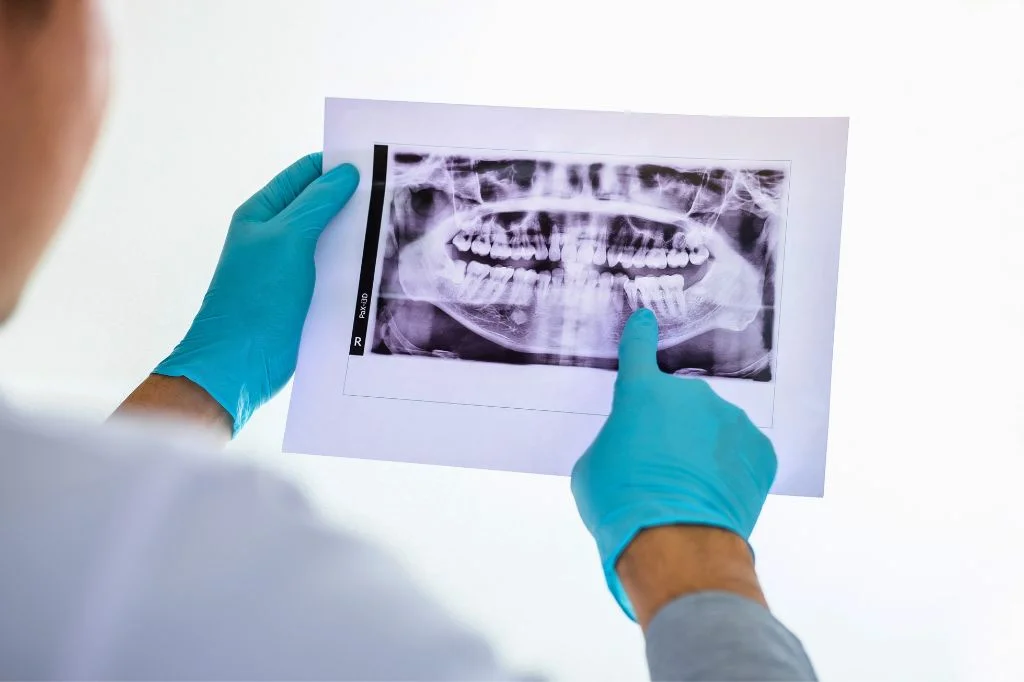
Many of the most destructive dental conditions progress without any initial pain or visible swelling. A yearly dental x-ray is vital for identifying asymptomatic cysts or impacted wisdom teeth that may eventually shift and damage neighboring molars.
Furthermore, imaging can reveal infections that might be aggravated by pressure shifts, a common concern linked to the tooth pain after flying experienced by frequent international travelers. By the time you feel a throb, the issue has likely reached a stage requiring more invasive and expensive treatment.
Safety Standards: Digital vs. Traditional X-Rays
Radiation concern is a common reason why some expats hesitate to undergo imaging, but modern technology has largely eliminated this risk. At a premium dental clinic in Bali, the shift to high-definition digital sensors means that patients are exposed to up to 90% less radiation compared to traditional film. These advanced dental safety standards ensure that a full set of digital images provides less radiation exposure than a day spent in the tropical sun or a single short-haul flight.
Financial Foresight: Saving Through Prevention
Investing in annual imaging is a strategy for long-term financial health. The cost of a diagnostic scan is negligible compared to the thousands of dollars required for emergency root canals or dental implants.
By identifying a small cavity today, you avoid extensive restorative work later. Regular imaging, combined with a dental check-up every six months, is the most cost-effective way to manage your healthcare budget while living abroad.
Conclusion
A yearly dental X-ray provides a “health baseline” to track changes in your bone and tooth structure over time. By debunking common dental myths regarding radiation, you can make informed decisions about your wellness. Trusting the advanced diagnostics at Hydro Medical ensures that hidden problems are resolved early, keeping your Bali lifestyle pain-free and uninterrupted.
SEE THE UNSEEN BEFORE IT HURTS.
Most dental emergencies start as invisible issues beneath the surface. Our high-definition, low-radiation digital X-rays can identify problems months before they cause pain, saving you time and stress.
Frequently Asked Questions (FAQ)
Is a dental X-ray really necessary every year?
For most adults, a yearly X-ray is the gold standard for catching decay between teeth and monitoring bone levels before symptoms appear.
How much radiation is in a digital X-ray?
Very little; the exposure from a digital dental X-ray is roughly equivalent to the background radiation you receive during a short domestic flight.
Can’t my dentist just see a cavity with a mirror?
No; mirrors only see the surface. X-rays are required to see decay hidden between teeth or lurking under old fillings.
What is the difference between a bitewing and a panoramic X-ray?
Bitewings focus on specific teeth to find cavities, while a panoramic X-ray provides a broad view of the entire jaw, sinuses, and joints.
Are X-rays safe for pregnant women?
While radiation is minimal, we typically postpone elective X-rays during pregnancy unless there is an urgent dental emergency.
What happens if I skip my yearly X-ray?
You risk allowing a painless, hidden cavity to grow into a major infection that could lead to a root canal or tooth loss.
Does Hydro Medical provide X-rays on-site?
Yes, we utilize high-definition digital sensors in-house for immediate results and maximum patient safety.
Can X-rays detect cysts or bone abnormalities?
Yes, panoramic imaging is vital for finding cysts, tumors, and bone issues that are invisible during a physical exam.
Why do I need an X-ray if my teeth don’t hurt?
Pain is a late-stage symptom; X-rays are designed to catch problems in the early stage when treatment is simple and affordable.
How long does it take to get the results?
Because we use digital technology, your X-ray images are available for review on our monitors instantly after they are taken.